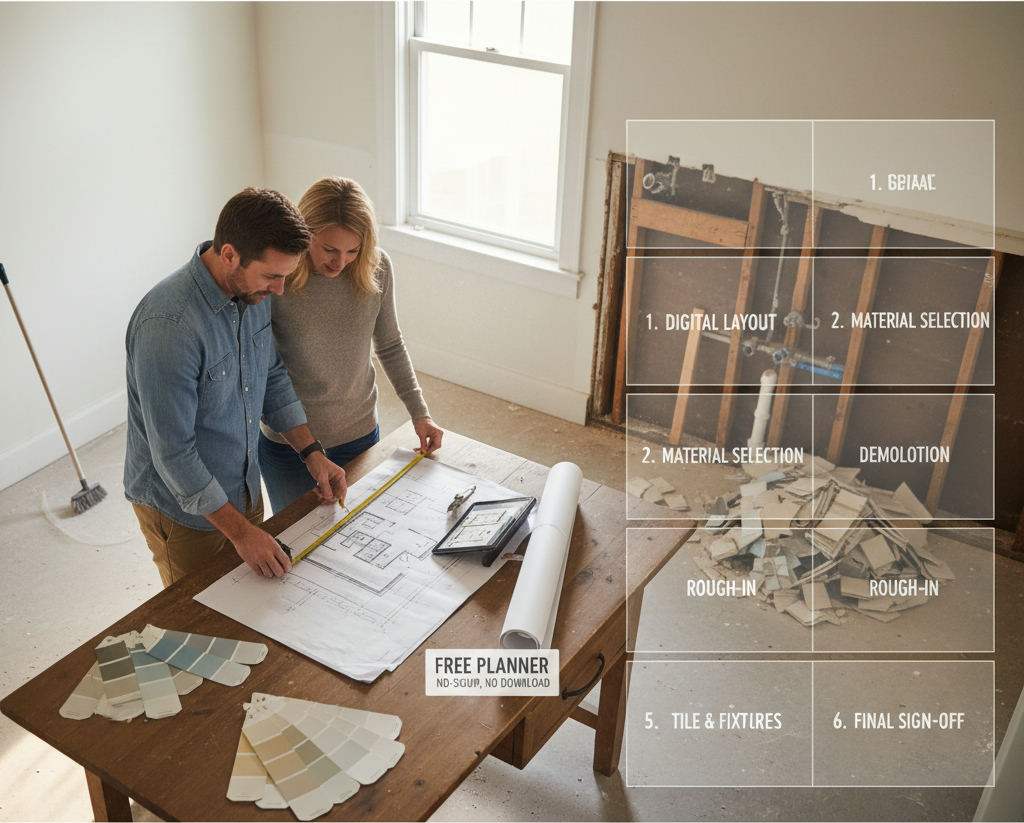
A spring bathroom renovation project timeline is a phased plan that takes you from initial layout sketches through contractor briefing, materials sourcing, the active build, and final sign-off — typically spanning eight to twelve weeks from first decision to finished room.
By Free Room Planner Team · Last updated: June 2026TL;DR
- Spring is a strong window for bathroom work — contractors are more available after the winter slowdown
- Lock in your layout digitally before contacting anyone; it prevents costly mid-project changes
- Order fixtures and tiles at least four to six weeks before your start date
- Export your floor plan as an image and use it as your contractor brief — it replaces back-and-forth emails
- The active build runs roughly three weeks; snagging and sign-off take a few days more
It's late February. The bathroom grouting is grey, the cabinet door sticks, and spring feels like the right moment to finally do something about it. Most homeowners stall here — not because of budget, but because they don't know where to start. The fix is simpler than it sounds: map every phase online before any money changes hands, and the rest of the project follows a clear sequence.

Why Spring Is the Right Time to Renovate a Bathroom
Contractors tend to free up after the winter slowdown, so you have more choice and less pressure when booking. Fixture and tile lead times are more predictable in spring than in the pre-Christmas rush. Natural daylight also makes it far easier to judge tile colours and lighting decisions accurately. For most of Europe, the UK, and North America, the March-to-May window is genuinely the best slot of the year.
The 6 Phases of a Spring Bathroom Renovation Timeline
Here is the full arc at a glance:
- Phase 1 (Weeks 1–2): Picture your layout using a free browser-based planner
- Phase 2 (Weeks 2–3): Define scope and set a realistic budget
- Phase 3 (Weeks 3–6): Source fixtures, tiles, and materials early
- Phase 4 (Week 6): Brief your contractor with a shareable floor plan
- Phase 5 (Weeks 7–9): The active build — strip-out through to finishing
- Phase 6 (Week 10): Snagging, sign-off, and final touches
Phase 1 — Picture Your Layout Before Anything Else
Drawing your bathroom layout digitally is the single most important step — and it costs nothing. A free browser-based bathroom layout planner with no sign-up, no download lets you set your room dimensions, drop in fixtures to scale, check door swings and clearances, and try different arrangements in minutes.
Why does this matter so much upfront? Because changing a layout on screen costs zero. Changing it once the plumber has roughed in the waste pipe costs hundreds. Locking in the plan now — before you contact a single tradesperson — is the step that keeps everything else on schedule.
This approach also replaces the need for a £500–£1,500 design consultation. You arrive at the contractor conversation already knowing what you want and where it goes.
Phase 2 — Define Your Scope and Set a Realistic Budget
Once you can see your layout clearly, scope becomes obvious. A cosmetic refresh — new tiles, taps, and a vanity unit in the same positions — is a two-to-three week job. A full remodel that moves the shower, relocates waste pipes, or changes the window position is a four-to-six week project in most regions, though complexity and contractor availability can shift that significantly.
Use your floor plan as a reference when requesting quotes. When every contractor is quoting from the same visual brief, comparisons are straightforward and surprises in the final invoice are far less likely.
| Renovation Type | Typical Duration | Approximate Budget Range |
|---|---|---|
| Cosmetic refresh (tiles, taps, vanity) | 1–3 weeks | £2,000–£5,000 |
| Mid-range remodel (new suite, retile) | 3–5 weeks | £5,000–£12,000 |
| Full remodel (plumbing relocation, layout change) | 4–8 weeks | £12,000–£25,000+ |
Phase 3 — Source Fixtures, Tiles, and Materials Early
Order everything at least four to six weeks before your intended start date. Supply chains for bathroom products are unpredictable. Brassware in particular can take three to four weeks during peak spring season, depending on availability. Wall and floor tiles from overseas suppliers occasionally run longer.
Having a scaled floor plan removes the guesswork from ordering. Use our tile calculator to estimate tile quantities, boxes, waste and grout from your room dimensions instead of guessing by eye. The same plan tells you the precise footprint of your bath, shower tray, or vanity unit before you commit to buying.
For help measuring your space accurately before you order, the online room dimension calculator guide walks through the process step by step.
Phase 4 — Brief Your Contractor With a Shareable Floor Plan
This is where preparation pays off visibly. Export your floor plan as a clean image file and send it to every contractor you're quoting. That single document communicates wall lengths, fixture positions, door clearances, and your intended layout — without a lengthy phone call or a site visit just to clarify basics.
Contractor miscommunication is one of the most common reasons bathroom renovations go wrong. A shower alcove measured verbally — "about 90cm" — ends up tiled at 85cm, and the shower tray doesn't fit. A vanity unit described in an email ends up on the wrong wall because the contractor assumed a mirror-image layout. Your floor plan becomes your insurance against both of those scenarios.
According to Sweeten, a renovation platform that has tracked thousands of bathroom remodels, unclear briefs and scope changes mid-project are among the leading causes of cost overruns (source: sweeten.com). A visual brief eliminates most of that ambiguity before work starts.
If you're also planning a kitchen at the same time, the same workflow applies — see the kitchen cabinet layout planner guide for the kitchen equivalent.
Phase 5 — The Active Build Phase (Week by Week)
For a standard full bathroom remodel, expect roughly three weeks of active work:
- Week 1: Strip-out and prep. Old fixtures, tiles, and fittings come out. The plumber and electrician first-fix their runs. Expect dust, noise, and no bathroom access — arrange an alternative from day one.
- Week 2: Plumbing second-fix and tiling. Walls and floors are tiled once the waterproofing membrane is applied. This is the phase most homeowners underestimate for duration — grout needs curing time before anything is sealed.
- Week 3: Fixtures, fittings, and finishing. The bath, shower, toilet, and vanity go in. The electrician returns for second-fix lighting and extractor fan. Sealant is applied last.
Cosmetic refreshes (tiling only, no plumbing changes) typically run one to two weeks. Plan for the longer end of any estimate — tradespeople rarely finish early.
Phase 6 — Snagging, Sign-Off, and Final Touches
Before you make final payment, walk through the finished bathroom with your contractor and check everything methodically. The British Institute of Kitchen, Bedroom & Bathroom Specialists (BiKBBI) recommends a structured snagging walkthrough as standard practice before any project is signed off.
Check: grout lines for consistency, sealant beads for continuity, fixture alignment against the plan, tile cuts at edges and corners, door and drawer clearance, and extractor fan operation. Your original floor plan makes this straightforward — you can compare what was built against what was agreed, fixture by fixture.
Any items that need correcting go on a snagging list with a clear deadline. Do not release final payment until the list is clear.
The Most Common Reasons Spring Renovations Run Over Schedule
These four problems account for the vast majority of delays:
- Late material orders. Tiles or a bath arriving after work has started means the tiler waits — and you pay for their time regardless.
- Scope creep. "While you're at it" additions — a new heated towel rail, an extra socket — each add days and cost. Decide everything before work starts.
- Unclear contractor briefs. Verbal descriptions of layouts lead to assumptions. A shared floor plan removes this entirely.
- Fixture lead times. Some brassware and shower enclosures have four-to-six week lead times. Order before you book the contractor, not after.
How to Use a Free Bathroom Planner to Map Your Timeline
Here is the exact sequence to get your plan ready before you contact anyone:
- Open the free bathroom planner at freeroomplanner.com — no sign-up, no download, no payment required.
- Set your room dimensions. Measure your bathroom walls and enter them. Use the live dimension labels to check wall lengths; metric walls snap in 1cm steps.
- Add fixtures to scale. Drop in your bath, toilet, shower, and vanity unit. Move them around to test different arrangements.
- Check clearances. Confirm door swings don't clash with fittings and that there's enough standing room at the shower and sink.
- Export the plan. Download a clean PNG image and attach it to every contractor quote request you send.
The whole process takes under ten minutes for a typical bathroom. You'll arrive at every contractor conversation with a precise brief rather than a rough sketch — and that changes the quality of every quote you receive.
If you're planning multiple rooms at the same time, the same principle applies. The furniture arrangement tool guide shows how to extend this approach to living spaces.

Conclusion
A spring bathroom renovation stays on track when the planning phase gets as much attention as the build phase. Draw the layout first. Order materials early. Brief your contractor with a shareable floor plan. Then let the build follow the plan.
Open the free bathroom planner now, set your dimensions, and have a complete floor plan ready before you make a single call. No sign-up. No download. Just a clear picture of what you want — and a document your contractor can actually work from.
Frequently Asked Questions
Here are the questions homeowners most commonly ask when planning a spring bathroom renovation.
How long does a spring bathroom renovation take from start to finish?
Most full bathroom renovations take eight to twelve weeks from the first planning decision to final sign-off, depending on project complexity and regional contractor availability. The active build phase typically runs three weeks. The remaining time covers planning, materials sourcing with four-to-six week lead times, and the snagging process at the end.
When should I book a contractor for a spring bathroom renovation?
Book your contractor at least six to eight weeks before your intended start date. Spring is a busy period — contractors who are available in March or April are often already booked by January. Having your floor plan ready when you make contact significantly speeds up the quoting process.
Do I need planning permission to renovate a bathroom?
In most cases, a standard bathroom renovation — replacing fixtures, retiling, and updating fittings in the same positions — does not require planning permission in the UK, US, or Canada. However, structural changes, moving load-bearing walls, or converting a room into a bathroom may require a permit. Always check with your local authority before starting work that changes the building structure.
What is the biggest mistake homeowners make when planning a bathroom renovation?
Ordering materials too late is the single most common cause of delays, according to renovation industry guidance. Tiles, brassware, and shower enclosures can have lead times of three to six weeks. Order everything before your contractor's start date — not after work has begun.
Can I use a free online planner to draw my bathroom layout accurately?
Yes. A browser-based bathroom planner with snap-to-grid accuracy lets you set exact room dimensions, position fixtures to scale, check clearances, and export a floor plan as an image. This approach is faster and less expensive than using professional design tools, and the exported plan gives contractors a precise visual brief to quote from.