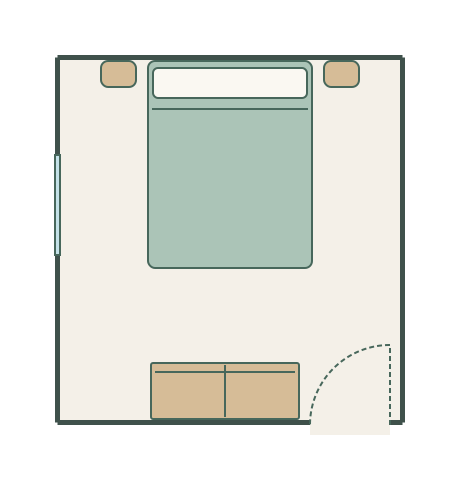
Bed and wardrobes
3.4 × 3.6 m · example room
A centred bed, two bedside tables and storage at the foot.
The bedroom planner is a free online tool for trying every furniture arrangement before you move a single item. Draw your bedroom to scale, drag beds and wardrobes, check clearances, and find the layout that works — all free.
Open a furnished example and adjust each wall and item to your room. These are editable plans at the sizes shown.
3.4 × 3.6 m · example room
A centred bed, two bedside tables and storage at the foot.
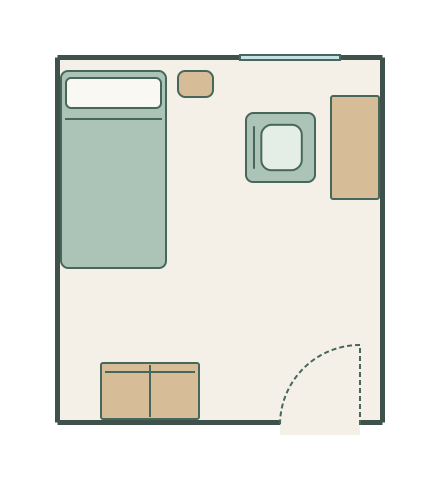
3.2 × 3.6 m · example room
A single bed and a compact workspace on opposite walls.
Choose a square, rectangle, L-shaped or T-shaped room and enter its inside dimensions. Or start on a blank grid.
Measure your bedroom walls and draw them to scale. Mark door, window, and radiator positions — these constrain where furniture can go.
Drag the bed, wardrobes, and other furniture from the library. Try the bed on every wall. Rotate wardrobes. Check clearances — you need 60–90 cm alongside the bed.
Once you've found the layout that works, export the plan. Use it to order fitted wardrobes, guide a removal team, or share with an interior designer.
Draw your bedroom walls to the centimetre so you know exactly what will fit.
King, queen, single beds, fitted wardrobe outlines, desks, dressers — all in the furniture library.
Check you'll have enough space to walk around the bed — plan it first, buy the bed second.
Mark door swings and window positions so your furniture doesn't block either.
Add room labels like 'walk-in wardrobe' or 'study corner' to communicate your intent clearly.
Download your bedroom plan as a PNG and share with interior designers or furniture retailers.
You'll need at least 60 cm alongside the bed to walk past comfortably, and ideally 90 cm if two people need to access both sides. At the foot of the bed, allow at least 90 cm if there's a wardrobe or door opposite. Use Free Room Planner to check these clearances before committing to a bed size.
In most bedrooms the bed is the focal point, ideally centred on the longest wall away from the door. If your room has a chimney breast or architectural feature, that can also anchor the bed position. Mark it in Free Room Planner first.
Fitted wardrobes are typically 60 cm deep. If your bedroom can fit a run of wardrobes along one wall, draw them in Free Room Planner first to check they don't block the door or eat too much floor space. Sliding doors need no swing clearance — useful in tight rooms. For more space-saving ideas, see our small bedroom layout guide.
For a bedroom that doubles as a home office, natural light from a window is important — position the desk perpendicular to the window where possible to avoid glare. Mark this in Free Room Planner alongside the bed to ensure both uses are compatible.
Note radiator positions in Free Room Planner — placing a wardrobe in front of a radiator is a common and expensive mistake. Plug socket positions can also determine where a bedside table can sit. Mark them in your plan before finalising the layout.
Plan around real dimensions. Drop these sizes into the planner to check a bed and wardrobe actually fit before anything gets carried upstairs.
Mattress width × length. Add a few inches for the frame.
| Twin | 38" × 75" |
| Twin XL | 38" × 80" |
| Full / Double | 54" × 75" |
| Queen | 60" × 80" |
| King | 76" × 80" |
| California King | 72" × 84" |
Mattress width × length in centimetres.
| Small Single (2'6") | 75 × 190 cm |
| Single (3'0") | 90 × 190 cm |
| Small Double (4'0") | 120 × 190 cm |
| Double (4'6") | 135 × 190 cm |
| King (5'0") | 150 × 200 cm |
| Super King (6'0") | 180 × 200 cm |
Typical width × depth — the footprint each piece needs on the floor.
| Nightstand | 16–20" × 16" |
| Chest of drawers | 30–40" × 18" |
| Double wardrobe | 40" × 24" |
| Desk | 40–48" × 24" |
Typical width × depth in centimetres.
| Bedside table | 40–50 × 40 cm |
| Chest of drawers | 80–100 × 45 cm |
| Double wardrobe | 100 × 60 cm |
| Desk | 100–120 × 60 cm |
A layout can look fine on paper and still feel cramped. Keep these gaps clear so you can walk around, open drawers and make the bed.
On the side you use to get in and out. 60 cm works at a push in a tight room.
Enough for the doors to open and for you to stand and reach inside.
To walk past comfortably. 60 cm is the tight minimum if space is short.
When one long side is pushed toward a wall, leave a little room to tuck bedding.
So a chest of drawers pulls out fully with room to stand in front of it.
Place your bed and storage at these sizes and the planner shows the walkways to scale.
Open the bedroom planner →Drop one of these into the planner and adjust it to your room.
Centred on the wall opposite the door with matching nightstands. Balanced, and it makes the bed the focal point.
Push one long side to the wall to open a single clear walkway — the most floor space in a tight room.
Two sides against the walls frees the rest of the room for a wardrobe and desk. Ideal for box and children’s rooms.
When the only free wall has the window, place the bed beneath it and keep storage on the solid walls.
Bed centred, matching nightstands, and a chest or wardrobe flanking each side for a calm, hotel-like balance.
Bed on one wall, a desk or reading corner on another, with a clear route between the two. For guest rooms and studios.
Planning new finishes too? Use the flooring calculator to estimate floor area, packs and waste, then calculate paint for every wall with the paint calculator. See all calculators.
Planning a different room? Use the planner built for it — same canvas, same free export.
Plan your kitchen layout with units, appliances, and islands.
Position sanitaryware and fittings before the plumber arrives.
Arrange sofas, tables, and entertainment units for the perfect living space.
Draw whole-floor plans with multiple rooms, doors, and windows.
The bed position determines almost everything else in a bedroom — where the wardrobe goes, whether the door swings freely, whether you can get into the loft hatch. Getting it wrong means a room that functions badly for years. Getting it right takes twenty minutes with a floor plan.
Draw your bedroom walls, drop in the bed, wardrobe, chest of drawers, and any fitted furniture. Resize everything to your actual dimensions. Try the layout three different ways in the time it would take to push the bed across the room once. Export the plan when you've found the arrangement that works.