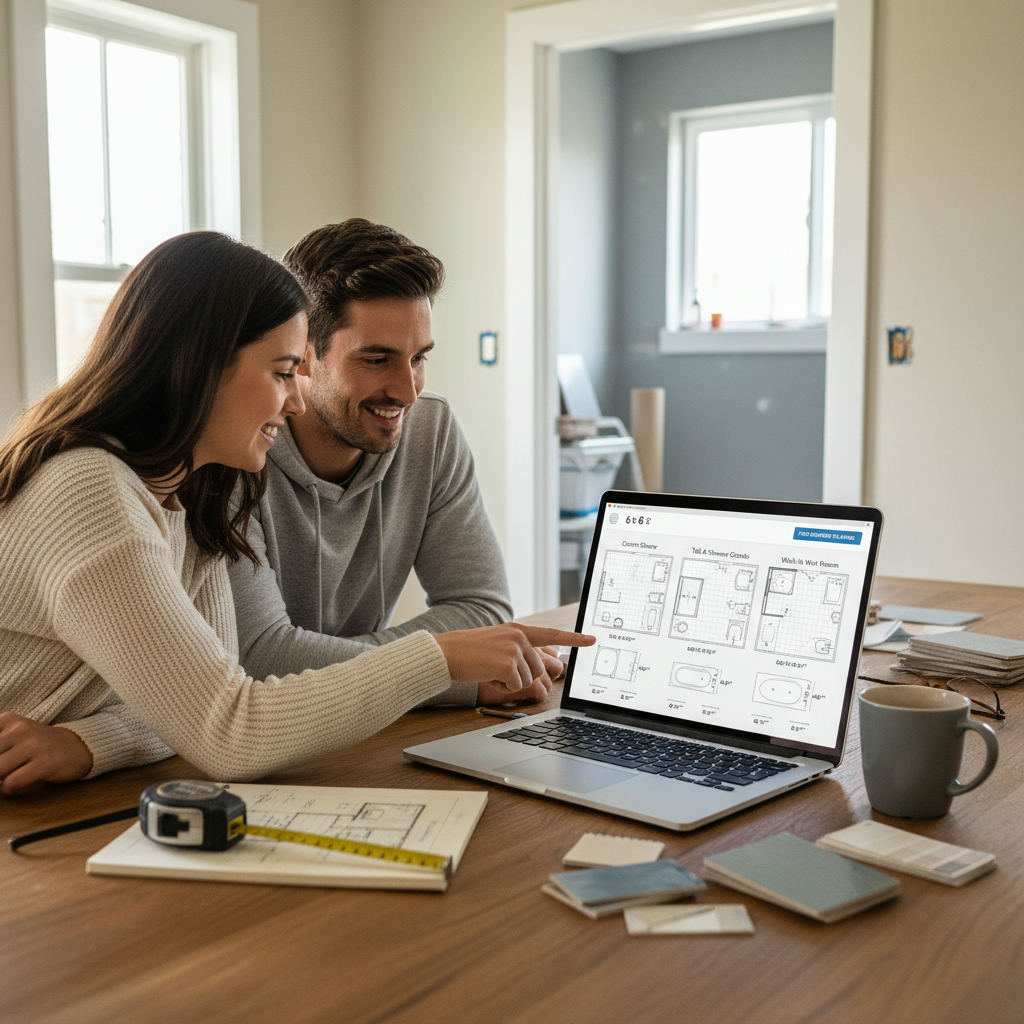
A 6x8 bathroom gives you 48 square feet to work with — enough for four proven layouts, from a full tub-and-toilet setup to a walk-in shower with double sinks.
In this article
- Why 6x8 Feels Limiting but Works Harder Than You Expect
- How to Read a 6x8 Bathroom Floor Plan
- Layout 1: The Classic Tub-Shower Combo
- Layout 2: Walk-In Shower Only, No Tub
- Layout 3: The Double Vanity Configuration
- Layout 4: The Wet Room or Open-Plan Shower
- Test These Layouts and Beyond With the Free Planner
- Common 6x8 Bathroom Planning Mistakes
- Frequently Asked Questions
- Start Planning Your 6x8 Bathroom Today
TL;DR: Forty-eight square feet fits more than you'd think. This guide walks through four 6x8 bathroom layout ideas with real fixture dimensions and honest trade-offs, then shows you how to test each one in a free browser-based planner — no sign-up, no download, no maths. You can also open pre-built layouts for other small bathroom sizes for wider inspiration.
Skip the Pinterest spiral. Start with a floor plan that actually fits.
Why 6x8 Feels Limiting but Works Harder Than You Expect
Forty-eight square feet sounds tight. In practice, it fits a full tub, a toilet and a single vanity — or, drop the tub, and you gain room for a generous walk-in shower with two sinks. What decides your layout isn't the floor area. It's two things: where the door swings and where the window sits.
Get those right and the rest falls into place. Get them wrong and even the most expensive fixtures feel awkward.
What 48 Square Feet Actually Gives You
A standard bathtub runs 30x60 inches (76x152 cm). A toilet footprint is roughly 14x28 inches (36x71 cm). A single vanity typically starts at 24 inches (61 cm) wide.
Add the clearance zones each fixture needs and you see why positioning order matters so much. The good news: all four layouts below fit standard fixtures. You don't need a compact or custom range to make a 6x8 bathroom work.
Which Two Variables Decide Your 6x8 Layout?
The door swing and window position decide your 6x8 bathroom layout before any fixture goes down. An inward-swinging door eats 10 to 12 square feet of floor space. Fixtures on the same wall as existing plumbing cost far less to install than relocated ones.
Swap an inward door for an outward swing or a pocket door — it's the single highest-impact change you can make. Mark your door and window first, then plan everything else around them.
How to Read a 6x8 Bathroom Floor Plan
A floor plan is a top-down view of your room drawn to scale. Walls show as thick lines, fixtures as standard symbols, and clearance zones — the space you need in front of each fixture — as open areas around them. Two minutes on clearance zones saves hours of replanning.
Minimum Clearance Rules for a 6x8 Space
These aren't legal requirements. They're the generally recommended minimums that make a bathroom feel usable rather than punishing:
- Toilet: 15 inches (38 cm) from the centre line to any wall on each side; 21 inches (53 cm) clear in front
- Vanity or sink: 21 inches (53 cm) clear in front
- Shower or tub: 21 inches (53 cm) clear for entry
- Door swing: the full arc must clear every fixture
In a 6x8 room these zones overlap fast. That's exactly why testing layouts before you buy anything matters.
How the Free Planner Handles Scale for You
Set your room to 6x8 and use the dimension labels to check the walls and fixtures against your measurements. Live dimension labels and the tape measure help you check gaps as you arrange fixtures. Confirm the measurements and required door clearances before choosing a layout.
Layout 1: The Classic Tub-Shower Combo
This is the most common 6x8 configuration, and for good reason. It works, contractors know it, and it uses the long wall efficiently.
Place the bathtub (30x60 in) along the 8-foot wall opposite the door. Position the toilet beside it on the same wall, keeping at least 15 inches from the tub edge to the toilet centre line. The single vanity (24–30 in) sits on the short wall facing the tub, leaving the door wall clear. Plumbing stacks neatly along one wall, which keeps installation cost down.
Best for: families with young children (a tub is still the easiest way to bathe a toddler), homes where a tub adds resale value, and anyone whose plumbing already runs along the long wall.
The trade-off: the tub takes more than half the floor plan, leaving limited room for storage or a second sink.
Layout 2: Walk-In Shower Only, No Tub
Dropping the tub is the single biggest upgrade you can make to a 6x8 bathroom — if your household doesn't need one. A walk-in shower immediately makes the room feel twice as large.
A 36x36 inch (91x91 cm) shower fits neatly into a corner. A 36x48 inch (91x122 cm) shower feels genuinely roomy and still fits along the 8-foot wall. Move the toilet to the opposite short wall, and a wider vanity (36–48 in) now fits on the remaining wall for meaningful counter space. Losing the tub surround frees up roughly 12 square feet of usable floor.
Storage and access gains: a threshold-free shower makes the room far more accessible — useful if anyone has mobility considerations or you plan to stay long term. The extra vanity width adds two to three more drawers than Layout 1's compact single.
This layout suits adults-only households wanting an open feel without a full wet-room build.
Layout 3: The Double Vanity Configuration
A double vanity in a 6x8 bathroom sounds ambitious. With the right compact shower it's entirely achievable — and it transforms a shared bathroom.
Keep the shower compact. A 32x32 inch (81x81 cm) corner unit leaves room for a 48-inch (122 cm) double vanity — two 24-inch basins side by side — on the opposite wall. Centre the toilet on the 6-foot end wall to keep plumbing runs short. The door must swing out or slide; an inward swing kills this layout immediately.
Double vanities start around 48 inches wide. Go narrower and the basin spacing gets uncomfortable for two people at once.
The trade-offs: you give up bathing space, and a 32x32 shower is functional rather than luxurious. Storage under a double vanity splits between two basins, so drawer depth shrinks. For two busy adults, the double vanity usually wins. For a family bathroom, Layout 1 or 2 serves better.
Layout 4: The Wet Room or Open-Plan Shower
A wet room removes the shower enclosure entirely. The whole floor is waterproofed and drained, the shower head sits on the wall, and the space opens up like no other layout.
Without an enclosure you reclaim the tray footprint and any screen framing — typically 6 to 10 square feet. Position the toilet and vanity along one 8-foot wall. The shower zone takes the far third of the room, separated by a low threshold or a change in tile pattern rather than a physical barrier. A linear drain (24–36 in) runs along the shower wall, and the floor pitches gently toward it. This is a job for a qualified tiler — the waterproofing layer makes or breaks a wet room.
Is it right for you? A wet room suits accessibility-first bathrooms and homes where a tub genuinely never gets used. Installation costs more than a standard enclosure, and ventilation becomes critical because the whole room gets humid. Budget for a quality extractor fan as non-negotiable. If a wet room feels like a stretch, Layout 2 gives you most of the open feel for far less.
Test These Layouts and Beyond With the Free Planner
These four configurations are a starting point, not a ceiling. Instead of picturing them, draw them. The free bathroom planner is browser-based — open it on a phone, tablet or desktop and start in under two minutes, with no sign-up and no download.
Beyond the 6x8 focus here, you can open pre-built layouts for other small bathroom sizes, giving you wider inspiration to adapt to your own room. It works like free floor plan software with no download — but simpler, because there's nothing to install.
Step by Step: From Blank Room to Finished Floor Plan
- Open the planner in your browser — no account, no payment.
- Set your dimensions to 6x8 feet (183 cm by 244 cm). Walls snap to the grid automatically.
- Mark your door and window on the correct walls — the step most people skip and later regret.
- Add fixtures from the library — bathtub, shower, toilet and vanity are all included. Drag each into place and resize with the handles.
- Check clearance zones using the live measurement display. Any overlap shows instantly.
Want to try Layout 1, then swap to Layout 2? A few drags does it. Comparing on screen takes seconds instead of hours of re-measuring. For a deeper look at getting dimensions right, the guide on drawing floor plans accurately applies the same principles.
Exporting and Sharing With Your Contractor
When the layout looks right, export it as a clean PNG straight from the browser — no account needed. Send the file to your fitter by email or message and they get an accurate floor plan with real dimensions, not a rough sketch that leads to costly surprises. Arriving with a document, not a description, is what briefing a builder with a floor plan is all about.
Common 6x8 Bathroom Planning Mistakes
Most 6x8 renovations go sideways at the planning stage, not the installation. These are the five that come up most, with a fix for each.
- Wrong door swing. An inward door blocks fixtures and shrinks usable space by up to 12 square feet. Fix: switch to an outward swing or pocket door before finalising anything.
- Undersized vanity. An 18-inch vanity looks fine on a mood board and feels cramped in use. Fix: go to at least 24 inches wherever clearance allows.
- Poor ventilation placement. A fan too far from the shower breeds condensation and mould. Fix: place it within 1 metre of the shower zone, rated for the room volume.
- Skipping clearance zones. Measuring footprints without the space in front is the most common error of all. Fix: use live measurements to check before you commit.
- Ignoring tile layout. Large-format tiles (12x24 in) create cut-waste in a 6x8 room, adding cost. Fix: sketch your tile grid before ordering.
Frequently Asked Questions
Quick answers to the questions homeowners ask most about 6x8 bathroom layouts.
Can a 6x8 bathroom fit a tub, toilet and vanity?
Yes. A 6x8 bathroom (48 square feet) comfortably fits a standard 30x60 inch tub, a toilet and a single 24–30 inch vanity along two walls. The key is stacking plumbing on one wall and keeping the door swinging outward so the fixtures stay accessible.
What is the best 6x8 bathroom layout for a small space?
For most small bathrooms, a walk-in shower without a tub gives the best sense of space, freeing roughly 12 square feet for a wider vanity and storage. If a tub matters for children or resale, the classic tub-toilet-vanity layout along the long wall is the safest choice.
Do I need software to draw a 6x8 bathroom floor plan?
No. You can draw an accurate 6x8 bathroom floor plan in a free browser-based planner with no download, no CAD skills and no sign-up. Snap-to-grid keeps measurements accurate, and you export the finished plan as a PNG to share with your fitter.
How much does a 6x8 bathroom renovation cost?
Costs vary widely by region, fixtures and whether plumbing is relocated. Keeping fixtures on their existing plumbing walls is the biggest single saving. A firm floor plan drawn before you brief a contractor helps you get accurate quotes and avoid mid-project change costs.
Is a walk-in shower better than a tub in a 6x8 bathroom?
For adults-only households, a walk-in shower usually wins — it opens the room, improves accessibility and adds vanity space. For families with young children or homes where a tub boosts resale value, keeping the tub is the wiser call.
Start Planning Your 6x8 Bathroom Today
Four layouts. One room. Forty-eight square feet that can work harder than you'd expect. The tub-shower combo suits families and resale. The walk-in shower opens the space. The double vanity transforms a shared bathroom. The wet room maximises accessibility at a higher cost.
None of it needs guesswork. See exactly where each fixture sits, check every clearance zone, and share a finished floor plan with your contractor — before you spend a penny on materials.
Already thinking about other rooms? The free kitchen planner and the guide on using a furniture arrangement tool online apply the same approach to the rest of your home.
Related guides
- Small Bathroom Layout Guide + Free Planner
- Small Bathroom Layout: Free Planner + 3 Ready-Made Configs