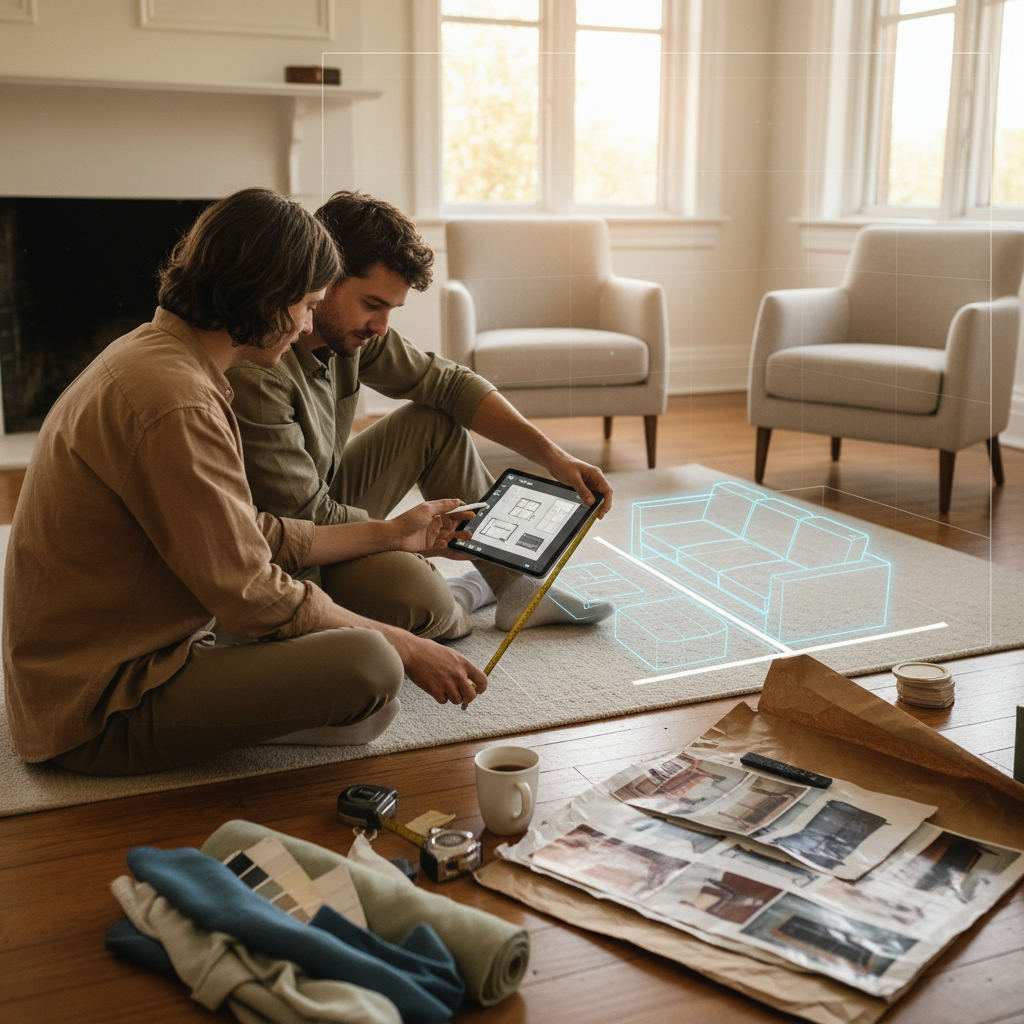
A living room furniture layout is the deliberate placement of seating, storage, and accent pieces to support natural movement, conversation, and comfort within a specific room shape and size.
In this article
- Key takeaways
- Why does furniture layout matter more than you think?
- Start with your room's measurements
- The four most common living room shapes
- What is the focal point rule?
- How much space should you leave between furniture?
- Furniture sizing: what actually fits
- Three ready-to-use layout arrangements
- Plan it free, then share with confidence
- Frequently Asked Questions
You know roughly how you want the room to feel. But you keep second-guessing whether the sofa will actually fit, whether the TV wall makes sense, or whether people will squeeze past the armchair every time they reach the door. Stop guessing. A free room planner lets you drag, drop, and test every arrangement before you move a single piece of furniture.
Key takeaways
- Measure your room first — length, width, door swings, windows, and fixed features.
- Build your layout around one focal point: fireplace, TV wall, or a large window.
- Leave 45 cm between your sofa and coffee table, and 90 cm for main walkways.
- Test every arrangement in the Free Room Planner before touching heavy furniture.
- Export your finished plan and share it with a partner, retailer, or contractor.
Why does furniture layout matter more than you think?
A poorly arranged living room costs money, not just comfort. Furniture that blocks a doorway gets moved. A sofa 10 cm too wide for its wall gets returned. A coffee table too small for the seating group gets replaced. A good layout plan eliminates these expenses before you spend a penny.
Good layout isn't a designer secret either. It's a set of practical rules — focal points, clearance distances, furniture proportions — that anyone can apply. The sections below walk you through each one.
Start with your room's measurements
Measure everything before you place a single piece of furniture. Accurate numbers are what separate a plan you can trust from a sketch you'll regret.
- Room length and width — measure at floor level, wall to wall.
- Door swings — note which way each door opens and how far it sweeps in.
- Window positions — mark their width and height from the floor.
- Fixed features — radiators, fireplaces, built-in shelving, and sockets all limit where furniture can go.
- Ceiling height — relevant for tall shelving and pendant lights.
Enter these into the planner using the snap-to-grid feature. Every wall, window, and door becomes an accurate boundary your furniture must work around — not a guess you'll pay for later. This is the same principle behind learning how to draw floor plans accurately.
The four most common living room shapes
Room shape drives layout decisions more than almost anything else. Here's what works for each of the four shapes you're likely dealing with.
Rectangular rooms
Anchor your primary seating to the longest wall. Place the sofa parallel to it and face it toward the focal point opposite. Avoid pushing everything against the walls — pulling the sofa 30 to 45 cm away creates a natural conversation area and makes the room feel larger, not smaller.
Square rooms
Square rooms need a strong focal point to avoid feeling boxy. Pick one wall — ideally with a fireplace or a TV — and arrange seating equidistant from it. A square or round coffee table works better here than a long rectangular one.
L-shaped rooms
Treat each arm of the L as a separate zone. Place the sofa at the internal corner facing the main focal point. Use an area rug to define the seating group and keep the secondary arm clear for a reading chair, desk, or dining set.
Open-plan living spaces
An open floor plan is defined by what you put in it, not by walls. Use furniture groupings and rugs to carve out a living zone, a dining zone, and the transition between them. A large rug under the sofa and coffee table defines a living area better than any amount of repositioning. For multi-use spaces, the furniture arrangement tool offers configurations worth testing.
What is the focal point rule?
The focal point rule means every successful living room layout faces toward one dominant feature — a fireplace, TV wall, or large window. That anchor determines where your sofa goes, where your armchairs angle, and how the whole room reads.
Three common focal point choices:
- Fireplace — place the sofa directly across from it, no more than 3 metres away for comfortable conversation.
- TV wall — mount the screen at eye level when seated (roughly 100 to 120 cm from floor to screen centre). Build the seating group so everyone sits within a 45-degree arc of the screen.
- Large window or garden door — useful when the room has a strong view. Face seating toward the window by day; add a floor lamp as a secondary anchor for evenings.
If your room has two potential focal points — a fireplace and a TV, say — pick one as primary and treat the other as accent. Rooms that try to serve two focal points equally end up serving neither.
How much space should you leave between furniture?
Leave 45 to 60 cm between the sofa and coffee table, 90 cm for main walkways, 50 cm around armchairs, and 60 cm between the TV and any foreground furniture. These clearance distances are where most living room layouts quietly fail.
The furniture fits, but the room doesn't work because nobody can move through it comfortably. Use these numbers as your baseline:
- 45 to 60 cm between the sofa and coffee table — enough to reach drinks and put your feet up without the table feeling miles away.
- 90 cm for main walkways — the path from doorway to seating and on to the rest of the house.
- 50 cm minimum around armchairs — enough to pass without turning sideways.
- 60 cm between the TV and any foreground furniture — stops pieces blocking the screen.
Check every distance in the planner before you commit. Move a piece 15 cm and instantly see whether the walkway drops below a safe width.
Furniture sizing: what actually fits
Getting proportions right is half the battle. Watch for these common sizing mistakes:
- Sofa too long for the wall — a standard three-seat sofa runs 210 to 230 cm. Add at least 15 cm clearance each side before a corner or doorway.
- Coffee table too small — aim for roughly two-thirds the length of your sofa. A 220 cm sofa needs a table at least 140 cm long.
- Rug undersized — the front legs of every sofa and armchair should sit on the rug. A rug only under the coffee table is one of the most common errors in otherwise well-arranged rooms.
- Console or TV unit blocking light — if the TV wall has a window nearby, keep the unit below 50 cm high so it doesn't interrupt daylight.
Don't forget the small pieces. An end table beside the sofa, a slim console behind it, and an ottoman that doubles as storage all earn their place once the anchors are set.
Three ready-to-use layout arrangements
Start from a proven arrangement and adapt it to your room:
- The Classic L — one sofa against the longest wall, two armchairs on the adjacent wall, all facing a TV or fireplace. A rectangular coffee table sits at the centre. Works in most rectangular rooms above 4 x 4 metres.
- The Conversation Circle — two sofas or a sofa and a loveseat facing each other across a central coffee table. Best for square or large rectangular rooms with a fireplace focal point. Keeps every seat the same distance from the centre.
- The Single-Wall Setup — one sofa, one coffee table, and an end table aligned to a single wall, with the rest of the floor clear. Best for narrow rooms under 3.5 metres wide where any second seating would block the walkway.
Replicate any of these in the planner by dropping in the pieces and adjusting dimensions to match what you own or plan to buy.
Plan it free, then share with confidence
Once your layout works on screen, export it as a clean PNG. Send it to a partner, show a furniture retailer so they can confirm stock dimensions, or hand it to a contractor if the room is part of a wider project. A floor plan removes the miscommunication that leads to returns, rework, and wasted spend — the same reason it pays to brief a builder with a floor plan.
The same tool handles kitchens, bathrooms, bedrooms, and full multi-room plans — no sign-up, no download, free. If you're also setting up a workspace, planning a home office layout follows the same measurement-first method.
Frequently Asked Questions
Quick answers to the questions homeowners ask most when arranging a living room.
How far should a couch be from the wall?
Pull the sofa 30 to 45 cm away from the wall rather than pushing it flat against it. That small gap creates a natural conversation area and makes the room feel more considered. In very small rooms you can drop this to zero, but a little breathing space almost always reads better.
Do I need free floor plan software with no download to do this?
No download or install is required. A browser-based planner lets you draw walls, add furniture at real dimensions, and export an image straight from any device. You avoid the cost and learning curve of desktop tools and skip the sign-up entirely.
Where should the TV go in a living room?
Mount the TV at eye level when seated — roughly 100 to 120 cm from floor to screen centre — and keep viewers within a 45-degree arc of it. Avoid placing it opposite a bright window, where glare washes out the picture during the day.
How big should my area rug be?
Choose a rug large enough that the front legs of every sofa and armchair in the group rest on it. This visually ties the seating together. A rug that floats under only the coffee table makes the whole arrangement feel disconnected.
Can I plan a living room layout before buying furniture?
Yes, and it's the smartest order to work in. Draw your room to scale, then drop in furniture at the exact dimensions of pieces you're considering. You'll see instantly whether a sofa fits its wall or a coffee table crowds the walkway — before you spend anything.